 Bitgetwallet
 gas fees
The gas charge shown in Bitget Wallet covers blockchain processing. Its size depends on the network, demand for block space and the work that the transaction performs. Swaps can also require separate approval transactions and incur route fees, while price impact and slippage can change the amount received.
Why the charge changes
On Ethereum, gas measures execution work and the gas price is the charge per unit. A token swap can consume more gas than a simple ETH transfer because it executes contract logic. Busy blocks can raise the price per unit even when the transaction itself is unchanged.
For Ethereum execution gas, the fee equals gas used multiplied by the effective gas price. If the price is quoted in gwei per gas unit, divide the result by 1,000,000,000 to express the charge in ETH. The effective price includes the base fee and the priority fee actually paid. Other blockchains have their own fee models.
The gas limit caps the units available for execution. The final charge uses the gas consumed, and unused gas is not charged. Lowering the limit does not reduce the work that a contract needs and can cause execution to run out of gas.
The fee token belongs to the network
| Network | Fee token |
|---|---|
| Ethereum | ETH |
| Base | ETH |
| Arbitrum | ETH |
| BNB Chain | BNB |
| Solana | SOL |
| Polygon | POL |
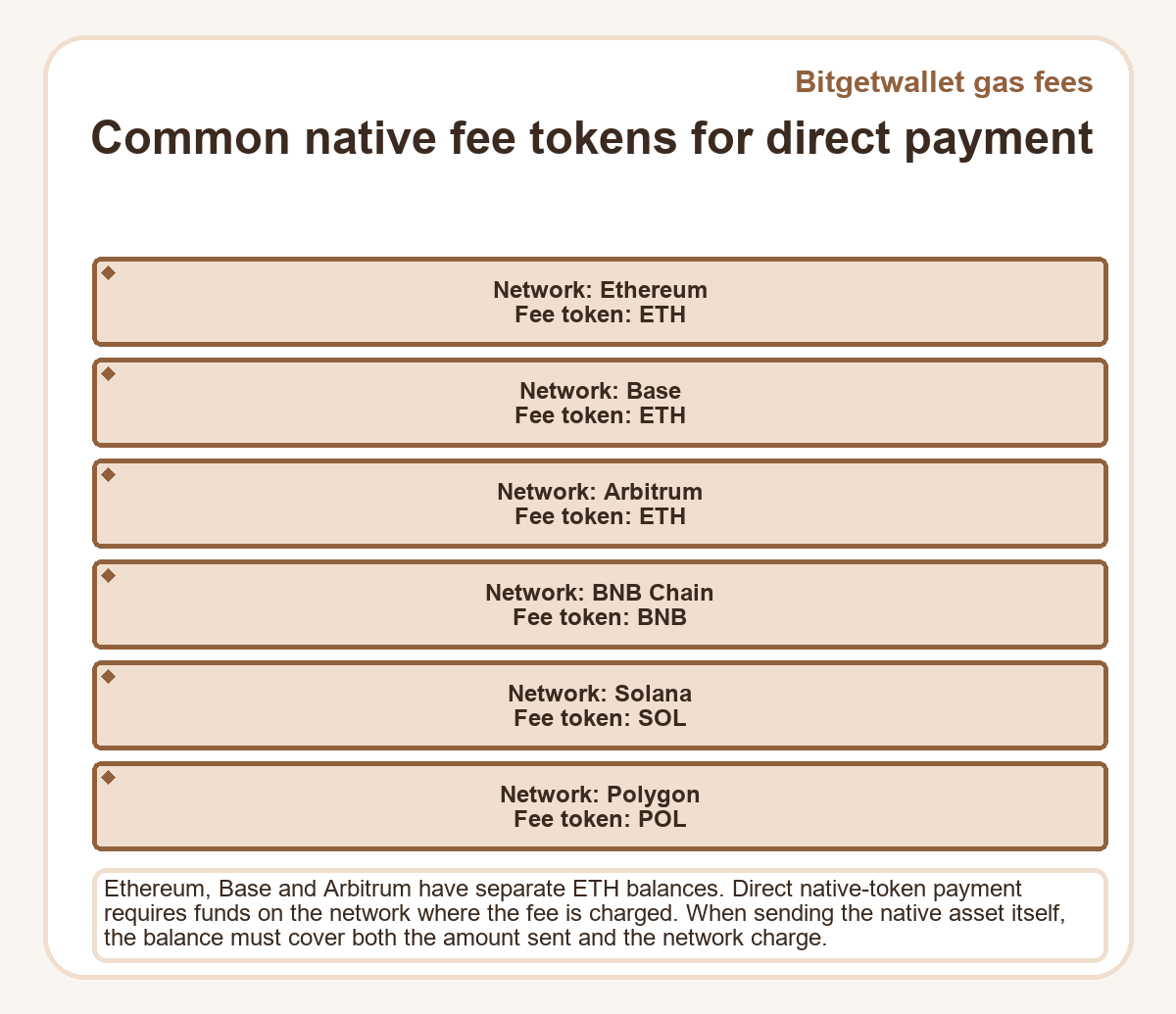
Ethereum, Base and Arbitrum have separate ETH balances. Direct native-token payment requires funds on the network where the fee is charged. When sending the native asset itself, the balance must cover both the amount sent and the network charge.
Other ways to fund gas
GetGas is a prepaid gas account inside Bitget Wallet. Accepted funding tokens include USDT and USDC on supported networks, and the balance can cover gas for supported operations. Available actions vary by network. Paying through GetGas still uses funds unless an applicable subsidy or voucher covers the charge. Where GetGas converts funds and transfers native gas tokens to your wallet, that extra transfer adds to the total network cost. Funding GetGas can also incur gas, although its help page lists the first top-up as gas-free.
For eligible USDT or USDC transfers and swaps selling either token, Bitget Wallet also supports deducting gas from the transaction amount when the native-token balance is insufficient. This option does not require a separate GetGas top-up. The documented networks are Ethereum, BNB Chain, Base, Arbitrum, Solana, Polygon, Optimism and Morph. The transaction confirmation screen shows the available payment options.
The Stablecoin Earn Plus FAQ describes a gas-free first subscription, followed by standard blockchain gas fees for later activity. It separately states that Bitget Wallet adds no management or service fee for that product.
Swap costs beyond gas
A same-chain swap exchanges assets within one blockchain. A cross-chain swap adds routing between networks, which can increase network charges. For routes through Bitget Wallet’s own liquidity, its Swap + Bridge fee schedule lists service fees of 0% to 0.5% for same-chain swaps and 0.3% to 1.3% for cross-chain swaps, depending on the token pair. The cross-chain fee combines bridge and swap charges. For the other routes listed in that fee schedule, including SwapKit, deBridge, Relay, SWFT and LayerZero, the listed service fee is 0.3%. These service fees exclude network gas. Where an on-chain token approval is required, that authorization can incur its own gas charge before the swap. Approval alone does not establish that the swap executed.
Price impact is the price change that a trade causes as it uses the available liquidity. Slippage is the difference between the quoted price and the execution price. Both can affect the output independently of gas. Compare routes using the same input asset, input amount, output asset and network pair. Review the estimated output alongside price impact and any separately displayed gas or service fees. A smaller output does not by itself show that the difference was spent on gas.
What estimates and final records establish
Bitget Wallet shows an estimated gas charge before signing. For an executed Ethereum transaction, gas used and the effective gas price establish its execution fee. A cross-chain route can involve several transactions, so one transaction record does not establish the total cost of the route.
An Ethereum transaction that executes and reverts still consumes gas. A request rejected before block inclusion has not incurred an Ethereum execution fee. Distinguish these states when investigating a failed swap; another attempt that executes can incur another fee.
Last updated